> ## Documentation Index
> Fetch the complete documentation index at: https://docs.agora.xyz/llms.txt
> Use this file to discover all available pages before exploring further.
# Transaction Simulation & Verification
> Deep simulation of DAO proposals using full governor and timelock context, with Tenderly support.
# Transaction Simulation & Verification
When a proposal is submitted on-chain, it's critical to ensure that what’s being executed is safe, transparent, and does exactly what the proposer intends. That’s where **Transaction Simulation & Verification** comes in.
This feature simulates the entire proposal execution **before it's ever executed**—using the **exact context of the governor, timelock, and the caller**. The simulation runs via [Tenderly](https://tenderly.co/), assuming it's supported by the target chain, and provides deep insight into the behavior of the proposal.
## Why Simulation Matters
Blockchain governance comes with irreversible consequences. Once a proposal passes, there's no undo button. That’s why simulation and verification are vital:
* Catch unexpected side effects
* Verify all contract interactions
* Ensure calldata decodes as expected
* Establish a full audit trail of proposal behavior before it's live
By integrating simulation into the governance process, DAOs increase safety and trust for all voters.
We run the same simulations when a proposal is in draft mode, giving the creator peace of mind before posting to the chain.
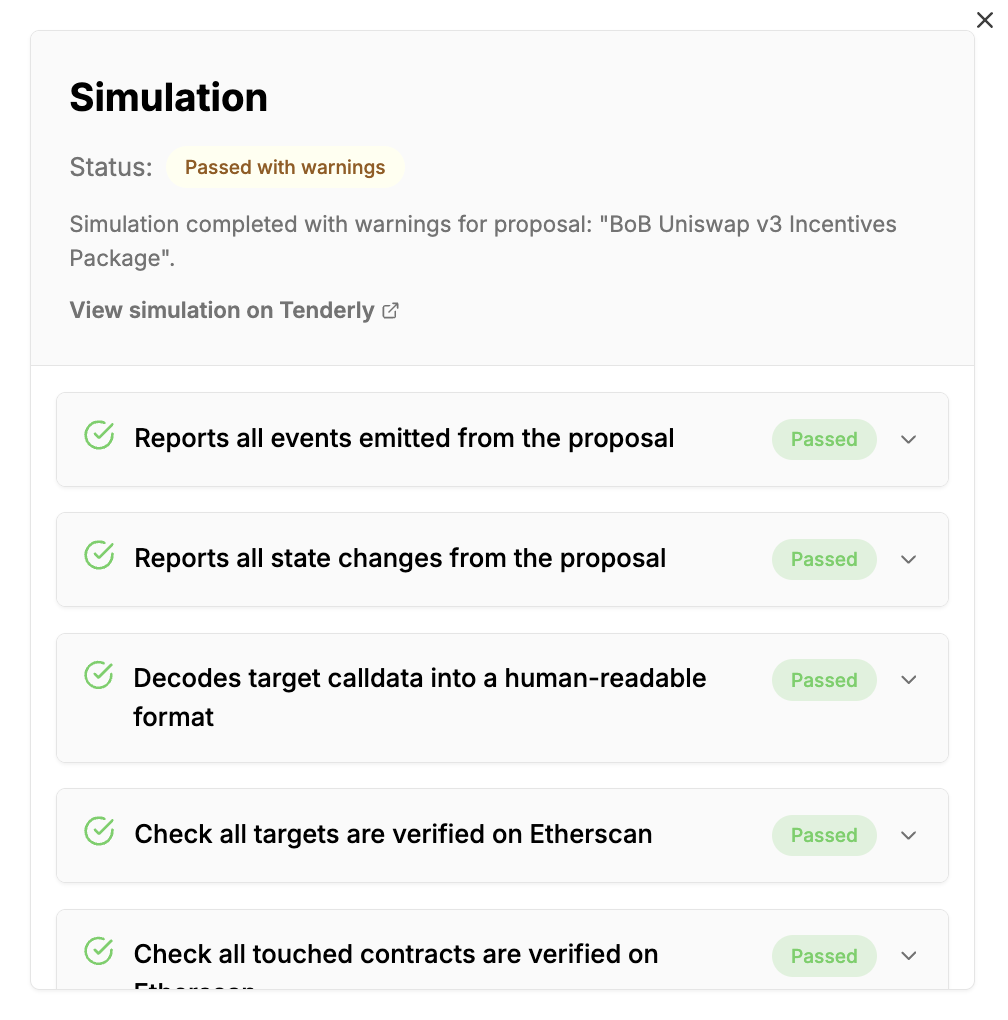
Below is a tiny screenshot of the feature.
 ***
## What We Check
When a simulation runs, we verify a comprehensive set of checks.
### ✅ Reports All Events Emitted
We capture and display **every single event emitted** during proposal execution. This allows reviewers to:
* Confirm expected events (e.g. token transfers, role assignments)
* Detect unexpected or hidden contract behavior
### ✅ Reports All State Changes
We log all **changes to contract storage**, including:
* Updated variables
* New values for mappings or arrays
* Any modifications made during execution
This helps confirm that the proposal impacts state exactly as intended—nothing more, nothing less.
### ✅ Decodes Target Calldata
All target calldata is:
* **Decoded into human-readable formats**
* Matched against known ABI definitions
This gives voters and reviewers confidence in the intent of each call and makes it easier to spot misconfigured or malicious data.
### ✅ Verifies All Targets on Etherscan
Each target address in the proposal is:
* Checked for **verified contract source code** on [Etherscan](https://etherscan.io/)
* Flagged if any address points to an unverified or proxy contract
### ✅ Verifies All Touched Contracts on Etherscan
Even if the proposal doesn't directly target them, we:
* **Track every contract that gets touched**
* Confirm verification status for those as well
> Because malicious contracts often use `delegatecall` or indirect hops to hide behavior—we catch those too.
### ✅ Checks for `selfdestruct` in Targets
We analyze each target contract and verify that:
* The bytecode does **not** include the `selfdestruct` opcode
* If present, this may indicate **dangerous or irreversible behavior**
> Proposals attempting to execute contracts with `selfdestruct` will trigger a warning or fail simulation, depending on context.
### ✅ Checks for `selfdestruct` in Touched Contracts
Even contracts indirectly touched during execution are checked for `selfdestruct`. A warning is raised if any are found.
### ✅ Detects ETH Sent With Proposal Execution
We check whether:
* The proposal attempts to send **ETH along with a call**
* If so, it is clearly reported for transparency
This protects against silent ETH transfers or unintentional funding of contracts.
### ✅ Reports All ETH Balance Changes
We analyze **ETH inflows and outflows** for:
* Target contracts
* Touched contracts
* The timelock or DAO itself
This ensures ETH movement is deliberate and easy to audit.
***
## Warnings
If something passes but raises a concern (e.g. unverifiable contracts or decoded calldata with unknown selectors), we **warn but do not block**. These warnings are meant to guide further manual review.
Simulation may pass with warnings. These indicate unusual behavior or unverifiable components that require additional scrutiny.
***
## View on Tenderly
Each simulation links to the full Tenderly trace, including:
* Execution traces
* Gas usage
* Storage diffs
* Event logs
***
## Under the Hood
* Simulations run as if the **governor’s `execute()`** function is being called by the **timelock**, simulating the **final step** in the lifecycle of a proposal.
* The full context includes the actual proposer, governor, timelock, and the current block timestamp.
* We simulate against **forked mainnet state** (where supported), providing real-world fidelity.
***
## Who Benefits?
* **DAO Voters** get peace of mind knowing what they’re voting on
* **Protocol Developers** can debug and verify proposals before submission
* **Governance Facilitators** can provide richer documentation and transparency to the community
## Big thanks to [Seatbelt](https://github.com/Uniswap/governance-seatbelt) 🧷
This feature was **heavily inspired** by the amazing work in the [Seatbelt project](https://github.com/Uniswap/governance-seatbelt), which laid the groundwork for many of the ideas around pre-execution simulation, calldata decoding, and safety verification.
If you're curious about how proposal-level simulations can be structured, we highly recommend checking out their codebase.
***
## What We Check
When a simulation runs, we verify a comprehensive set of checks.
### ✅ Reports All Events Emitted
We capture and display **every single event emitted** during proposal execution. This allows reviewers to:
* Confirm expected events (e.g. token transfers, role assignments)
* Detect unexpected or hidden contract behavior
### ✅ Reports All State Changes
We log all **changes to contract storage**, including:
* Updated variables
* New values for mappings or arrays
* Any modifications made during execution
This helps confirm that the proposal impacts state exactly as intended—nothing more, nothing less.
### ✅ Decodes Target Calldata
All target calldata is:
* **Decoded into human-readable formats**
* Matched against known ABI definitions
This gives voters and reviewers confidence in the intent of each call and makes it easier to spot misconfigured or malicious data.
### ✅ Verifies All Targets on Etherscan
Each target address in the proposal is:
* Checked for **verified contract source code** on [Etherscan](https://etherscan.io/)
* Flagged if any address points to an unverified or proxy contract
### ✅ Verifies All Touched Contracts on Etherscan
Even if the proposal doesn't directly target them, we:
* **Track every contract that gets touched**
* Confirm verification status for those as well
> Because malicious contracts often use `delegatecall` or indirect hops to hide behavior—we catch those too.
### ✅ Checks for `selfdestruct` in Targets
We analyze each target contract and verify that:
* The bytecode does **not** include the `selfdestruct` opcode
* If present, this may indicate **dangerous or irreversible behavior**
> Proposals attempting to execute contracts with `selfdestruct` will trigger a warning or fail simulation, depending on context.
### ✅ Checks for `selfdestruct` in Touched Contracts
Even contracts indirectly touched during execution are checked for `selfdestruct`. A warning is raised if any are found.
### ✅ Detects ETH Sent With Proposal Execution
We check whether:
* The proposal attempts to send **ETH along with a call**
* If so, it is clearly reported for transparency
This protects against silent ETH transfers or unintentional funding of contracts.
### ✅ Reports All ETH Balance Changes
We analyze **ETH inflows and outflows** for:
* Target contracts
* Touched contracts
* The timelock or DAO itself
This ensures ETH movement is deliberate and easy to audit.
***
## Warnings
If something passes but raises a concern (e.g. unverifiable contracts or decoded calldata with unknown selectors), we **warn but do not block**. These warnings are meant to guide further manual review.
Simulation may pass with warnings. These indicate unusual behavior or unverifiable components that require additional scrutiny.
***
## View on Tenderly
Each simulation links to the full Tenderly trace, including:
* Execution traces
* Gas usage
* Storage diffs
* Event logs
***
## Under the Hood
* Simulations run as if the **governor’s `execute()`** function is being called by the **timelock**, simulating the **final step** in the lifecycle of a proposal.
* The full context includes the actual proposer, governor, timelock, and the current block timestamp.
* We simulate against **forked mainnet state** (where supported), providing real-world fidelity.
***
## Who Benefits?
* **DAO Voters** get peace of mind knowing what they’re voting on
* **Protocol Developers** can debug and verify proposals before submission
* **Governance Facilitators** can provide richer documentation and transparency to the community
## Big thanks to [Seatbelt](https://github.com/Uniswap/governance-seatbelt) 🧷
This feature was **heavily inspired** by the amazing work in the [Seatbelt project](https://github.com/Uniswap/governance-seatbelt), which laid the groundwork for many of the ideas around pre-execution simulation, calldata decoding, and safety verification.
If you're curious about how proposal-level simulations can be structured, we highly recommend checking out their codebase.